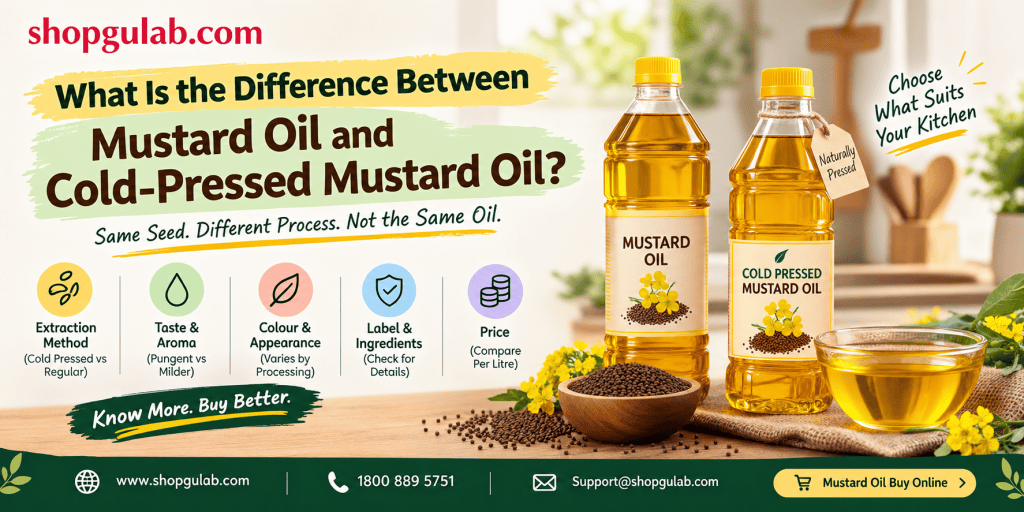
Mustard oil has a familiar place in Indian kitchens. From tadka and parathas to pickles and regional recipes, its sharp aroma and distinctive taste can instantly change the character of a dish. But while shopping, you may notice bottles labelled cold-pressed mustard oil, mustard oil, or even cold-compressed mustard oil. So, are they actually different?
The short answer is: mustard oil describes the oil, while cold-pressed mustard oil highlights the method used to extract it. Understanding this difference can make it easier to compare products, labels, prices, and quality instead of choosing only by appearance or marketing claims.
What Is Mustard Oil?
Mustard oil is an edible oil obtained from mustard seeds. It is traditionally appreciated for its strong aroma, pungency, and ability to complement many Indian dishes.
The term “mustard oil” alone does not necessarily tell you exactly how the oil was extracted. For that reason, when comparing two bottles, it is useful to read the product label and processing information rather than assuming every mustard oil is made in the same way.
FSSAI’s standards specifically define mustard oil and also provide conditions under which mustard oil may be labelled “Kachi Ghani” or “Cold Pressed.”
What Is Cold Pressed Mustard Oil?
Cold-pressed mustard oil refers to mustard oil produced through a pressing or mechanical extraction process rather than relying on solvent extraction.
The important point is that “cold pressed” describes how the oil is obtained. It does not automatically mean that every product carrying the phrase is identical in taste, colour, filtration, or overall characteristics.
For mustard oil specifically, FSSAI’s standard notes that oil may be labelled “Kachi Ghani” or “Cold Pressed” when its natural allyl isothiocyanate content meets the specified requirement.
This is why checking the actual label is more useful than treating “cold pressed” as just a premium-sounding phrase.
Mustard Oil vs Cold Pressed Mustard Oil: The Main Difference
Think of the distinction this way:
Mustard oil = what the oil is.
Cold-pressed mustard oil = what the extraction method tells you about the oil.
A bottle simply marked mustard oil gives you the product category. A bottle specifically marked cold-pressed mustard oil gives additional information about its extraction method and, where applicable, compliance with the relevant labelling requirements.
That difference can matter if you prefer traditionally pressed oils or are specifically looking for a particular processing method.
Does Cold Pressed Mean Better?
Not automatically.
This is one of the most important points shoppers often overlook. The words “cold pressed” can be useful, but they should not be treated as the only measure of quality.
When choosing the best cold-pressed mustard oil, look beyond the front label.
Check:
- The complete product name
- Ingredients and applicable declarations
- Extraction or processing information
- Net quantity
- Manufacturing or packing details
- Best-before information
- Packaging condition
- FSSAI licence details where applicable
- Seller and manufacturer information
- Whether the product matches your cooking requirements
FSSAI’s current Labelling and Display regulations provide the regulatory framework for food labels, with amendments continuing through 2026.
What About Cold Pressed Mustard Oil Price?
You may notice that cold-pressed mustard oil price varies considerably between brands and pack sizes. A higher price does not automatically prove that one oil is better.
Pricing can be influenced by several practical factors, including:
- Cost and quality of mustard seeds
- Extraction method
- Filtration and processing
- Packaging material
- Pack size
- Production scale
- Distribution and retail costs
- Brand positioning
For example, comparing a 1-litre bottle with a larger family pack purely by total price can be misleading. Looking at the price per litre gives you a more useful comparison.
At the same time, an unusually low price deserves a closer look at the label, packaging, seller information, and product details.
Is Cold Pressed Yellow Mustard Oil Different?
Cold-pressed yellow mustard oil generally refers to oil made from mustard varieties that produce a lighter or more yellow-looking oil. However, colour alone should not be used as proof of extraction method or purity.
Natural colour can vary depending on the mustard seeds, processing, filtration, and other production factors.
So, if you are shopping for cold-pressed yellow mustard oil, don’t make the decision simply because one bottle looks brighter or darker than another. Read the product information and compare the processing details.
Is Cold Compressed Mustard Oil the Same Thing?
You may also come across the phrase cold compressed mustard oil while searching online.
In everyday product discussions, “cold compressed” is often used to describe oil obtained through mechanical pressing. However, terminology can vary between sellers.
For a buyer, the practical approach is simple: don’t judge the product from the phrase alone. Look at the manufacturer’s description, label, regulatory information, and extraction details.
If a product claims to be cold-pressed or Kachi Ghani, the claim should be considered alongside the applicable food standards rather than treated as a guarantee of every desirable quality.
How Does the Taste Differ?
This is where the difference can become noticeable in the kitchen.
Mustard oil is naturally known for its pungent character. A cold-pressed version may appeal to people who specifically enjoy the characteristic flavour associated with traditionally pressed mustard oil.
However, taste can still vary from product to product.
The mustard seed variety, freshness, filtration, processing, and storage can all influence the final sensory experience. Two bottles that both say mustard oil may therefore taste somewhat different.
That’s why your own cooking habits matter.
If you regularly prepare pickles, Bengali-style fish dishes, Punjabi recipes, or other foods where mustard’s distinctive flavour is central, you may have a stronger preference for one product than someone who mainly uses oil for everyday frying.
Which Is Better for Cooking?
There isn’t one universal answer.
The right choice depends on your cooking style and what you value in an oil.
Choose regular mustard oil when:
- You want mustard oil for everyday cooking.
- You are comfortable with the product’s stated processing method.
- The label provides clear product information.
- The taste suits your family’s recipes.
- The price fits your regular grocery budget.
Consider cold-pressed mustard oil when:
- You specifically prefer mechanically pressed oils.
- You enjoy a distinctive mustard flavour.
- You want the extraction method clearly identified.
- You are willing to compare products beyond price.
- You regularly cook traditional recipes where mustard oil plays a prominent role.
The key is not to assume that one phrase on the bottle tells the whole story.
How to Choose the Best Cold Pressed Mustard Oil
If you’re standing in a supermarket aisle or comparing products online, use this simple checklist.
1. Read the front and back labels
Don’t stop at the product name. Important information is often found on the back or side panel.
2. Check the extraction claim
If you specifically want cold-pressed mustard oil, verify that the product clearly identifies itself accordingly.
3. Compare price per litre
Instead of looking only at the total amount, calculate the effective price for the same quantity.
4. Look at packaging
Choose packaging that is intact, properly sealed, and free from visible damage or leakage.
5. Check dates
Freshness matters for an edible oil. Check the relevant manufacturing, packing, best-before, or other date information provided on the package.
6. Don’t confuse colour with quality
A darker or brighter oil is not automatically better. Product quality cannot be established from colour alone.
7. Consider your cooking
An oil that works beautifully in a pickle or regional recipe may not be the flavour you want in every dish.
Is Cold Pressed Mustard Oil Healthier?
It is better to be careful with simple “healthy” versus “unhealthy” comparisons.
The extraction method is an important product characteristic, but it does not turn an oil into a cure or make health claims automatically valid. Overall dietary pattern, portion size, cooking habits, and the rest of the diet matter too.
For consumers, a better approach is to choose a properly labelled edible oil from a reliable source and use it sensibly as part of a varied diet.
For official food standards and consumer information, you can refer to FSSAI’s official standards and regulations.
A Simple Way to Remember the Difference
If you’re still confused, remember this:
Mustard oil tells you the source of the oil — mustard seeds.
Cold-pressed mustard oil gives you additional information about how the oil was extracted.
So, when comparing products, don’t ask only, “Which one says cold-pressed?”
Ask:
What is the product, how is it processed, what does the label tell me, and does it suit the way I cook?
That approach gives you a much more realistic basis for choosing an oil.
Final Thoughts
The difference between mustard oil and cold-pressed mustard oil is primarily about the information conveyed by the product description and extraction method. Cold pressing can be an important preference for shoppers, but it should be evaluated together with the label, processing details, packaging, freshness, price, and intended use.
If you’re looking for the best cold-pressed mustard oil, don’t let attractive packaging or a single marketing phrase make the decision for you. A little label-checking can tell you much more.
Contact Us: For product information and assistance with choosing mustard oil for your kitchen, contact Shop Gulab through its official support channels.


Leave a Reply