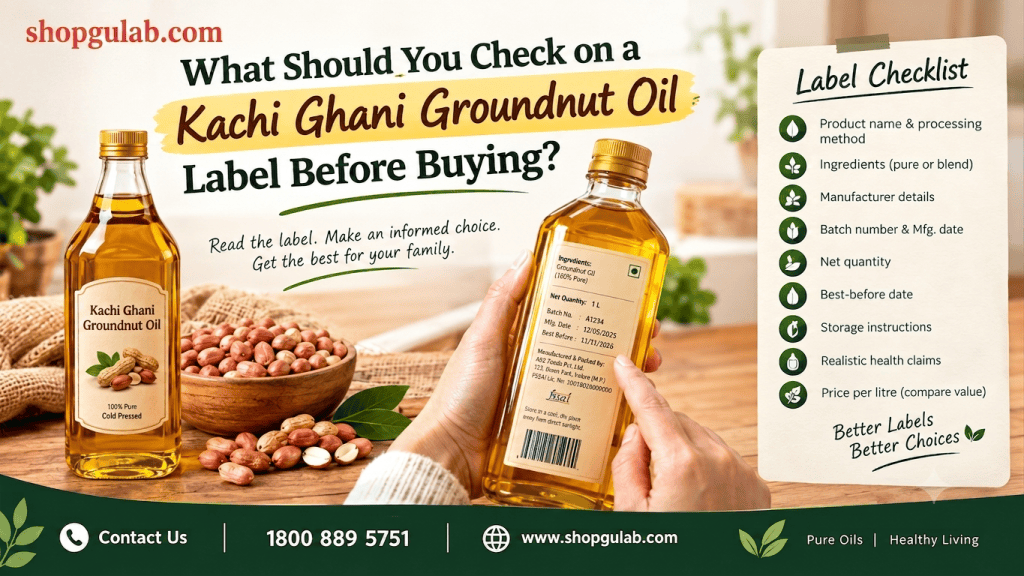
Buying cooking oil may seem straightforward until you stand in front of a shelf filled with bottles making claims such as “traditional,” “pure,” “cold-pressed,” and “premium.” When you specifically want kachi ghani groundnut oil, reading the label carefully can help you understand what you are actually purchasing.
Rather than choosing a bottle because of its packaging or a promotional claim, look at the product name, processing method, ingredients, quantity, dates, manufacturer information, and other label details. This approach is especially useful when comparing different brands and trying to understand why their prices differ.
Why Does the Label Matter?
The front of a bottle is designed to catch attention. The back and side panels usually contain the practical information needed to make a better purchasing decision.
Before buying kachi ghani groundnut oil, it is useful to understand the basic food-labelling requirements as well. The Food Safety and Standards Authority of India (FSSAI) provides regulations covering food labelling, packaging, and edible oils. Read the FSSAI Food Safety and Standards Regulations.
For kachi ghani groundnut oil, the label can help answer important questions:
- Is the product actually groundnut oil?
- What processing method is being used?
- Is it pure or blended?
- Who manufactured or packed it?
- What is the net quantity?
- When was it manufactured or packed?
- What is the best-before information?
- How should it be stored?
1. Check the Product Name First
Start with the simplest detail: the actual name of the oil.
If you’re looking for kachi ghani groundnut oil, check that groundnut oil is clearly identified on the package. Don’t assume that every product carrying attractive terms such as “traditional oil” is necessarily the same product or made through the same process.
The product name should give you a clear starting point before you move on to the finer details.
2. Understand What “Kachi Ghani” or “Ghani Oil” Refers To
The words ghani oil are commonly associated with traditional oil pressing. Buyers often choose this style of oil because they prefer the characteristic aroma and flavour associated with mechanically pressed groundnuts.
However, don’t rely on the term alone. Look for additional processing information on the label.
There is an important difference between understanding a traditional processing description and assuming that a product automatically has particular health benefits. Processing claims and nutrition claims are separate matters.
3. Look for Clear Processing Information
Processing is one of the most important things to examine when comparing edible oils.
You may come across descriptions such as:
Cold-pressed groundnut oil: generally refers to oil obtained through mechanical pressing at relatively low temperatures.
Refined groundnut oil: undergoes additional refining steps intended to remove undesirable compounds and alter characteristics such as odour and appearance.
If you specifically want kachi ghani groundnut oil, check whether the label clearly supports the processing method being advertised instead of relying only on a large marketing headline.
FSSAI’s standards and regulations provide specifications for edible oils and distinguish different processing categories and labelling requirements.
4. Check the Ingredients Panel
Never skip the ingredients section.
If you want pure groundnut oil, check whether the package identifies only the relevant oil or whether it indicates that the product is a blend.
This becomes particularly important when shopping online because product images can sometimes make several varieties look almost identical.
A useful habit is to compare the front label with the ingredients declaration. The two should tell a consistent story.
5. Look for Manufacturer and Brand-Owner Details
A transparent product label should make it reasonably easy to identify the business responsible for the product.
Check for details such as:
- Manufacturer or packer name
- Address
- Brand-owner information
- Customer-care contact
- Applicable food-business licence information
These details matter because traceability is an important part of food-product transparency.
A well-documented label gives consumers something concrete to refer to if they have questions about the product.
6. Check the Batch or Lot Information
The batch number may look like insignificant small print, but it provides useful traceability.
If you ever have a question about the quality or packaging of a particular bottle, the batch or lot information can help the manufacturer identify the production run.
This is one of those details that you may never need—until you do.
7. Don’t Forget Net Quantity
When comparing two bottles, don’t compare only their printed prices.
Check the actual net quantity first.
For example, a smaller bottle may appear cheaper at first glance, while a larger pack may provide a better price per litre. This is especially relevant when comparing cold-pressed groundnut oil prices across different pack sizes.
A practical approach is to calculate:
Price ÷ quantity = approximate price per litre
That gives you a more meaningful basis for comparison.
8. Check Manufacturing and Best-Before Information
Before putting the bottle in your shopping basket, look at the relevant date information.
This becomes particularly important when you are buying in bulk. A large pack may be economical only when your household can comfortably use it within the recommended period.
Once opened, proper storage is equally important. Keep the bottle tightly closed and follow the storage directions provided on the package.
9. Read the Storage Instructions
Groundnut oil should be stored according to the manufacturer’s instructions.
As a general household practice, keep cooking oil away from excessive heat, moisture, and direct sunlight. Closing the container properly after every use also reduces unnecessary exposure to air.
Good storage does not improve a poor-quality product, but poor storage can compromise an otherwise well-chosen product over time.
10. Don’t Judge Quality by Colour Alone
One common shopping habit is to judge edible oil by its colour.
That can be misleading.
The appearance of kachi ghani groundnut oil can vary due to factors such as the groundnut variety, processing method, filtration, and other production practices.
Instead of asking, “Is this colour right?” ask a more useful set of questions:
Is the product clearly identified? Is the processing information transparent? Are the ingredients clear? Are the manufacturer and batch details available?
Those checks provide more meaningful information than colour alone.
11. Be Careful With Big Health Claims
This deserves special attention.
Words such as “heart-friendly,” “cholesterol fighter,” or similar medical-sounding claims should not be accepted simply because they appear on packaging or advertising.
FSSAI regulations place restrictions on exaggerated expressions and certain claims relating to edible oils.
Cooking oil is one part of an overall diet. It is better to evaluate the product based on its ingredients, processing, quality information, suitability for your cooking, and overall dietary needs.
For broader guidance on fats, oils, and balanced eating, readers can refer to the ICMR-National Institute of Nutrition’s Dietary Guidelines for Indians. The guidelines discuss visible fats and recommend moderation in their intake.
12. Compare Value, Not Just the Lowest Price
Price matters, but the cheapest bottle is not automatically the best value.
When comparing cold-pressed groundnut oil price, consider the complete product:
Processing + quantity + packaging + manufacturer transparency + storage information + product specifications
For example, two one-litre bottles may have noticeably different prices because of differences in sourcing, processing, packaging, positioning, and distribution.
Instead of asking, “Which one is cheapest?”, ask:
“Which product gives me the information and characteristics I am actually looking for at a reasonable price?”
That is a much more useful buying question.
Kachi Ghani Groundnut Oil Buying Checklist
Before purchasing, spend one minute checking these points:
Product name: Is it clearly identified as groundnut oil?
Processing: Does the label clearly explain the pressing or refining method?
Ingredients: Is it pure oil or a blend?
Traceability: Are manufacturer, batch, and relevant product details available?
Quantity: Have you checked the actual net quantity?
Dates: Is the applicable manufacturing/packing and best-before information clear?
Storage: Are storage instructions provided?
Claims: Are the marketing promises realistic and understandable?
Price: Have you compared the price based on quantity rather than just the sticker price?
This simple process can make online and offline oil shopping much less confusing.
A Smart Way to Compare Different Brands
Suppose you have three bottles in front of you. Instead of immediately choosing the cheapest one, compare them side by side.
Look at the product description first. Then compare the processing information, ingredients, quantity, manufacturing details, dates, and price per litre.
You may find that the most suitable product isn’t necessarily the cheapest or the most expensive. It is the one that matches your preferences while providing clear and trustworthy product information.
That is especially useful when you’re trying to find the best option for everyday Indian cooking.
Final Thoughts
Choosing kachi ghani groundnut oil becomes much easier once you stop treating the label as decoration and start using it as a buying guide.
The most useful information is usually not the biggest text on the front. It is often found in the smaller details: ingredients, processing information, quantity, manufacturer details, batch number, dates, storage instructions, and realistic product claims.
A few extra seconds of label reading can help you compare products more intelligently and avoid decisions based purely on packaging or price.
For product details, pack sizes, or help choosing a suitable cooking oil, contact us today, and our team will be happy to assist you.
For traditionally processed cooking oils and related products, explore Shop Gulab.


Leave a Reply