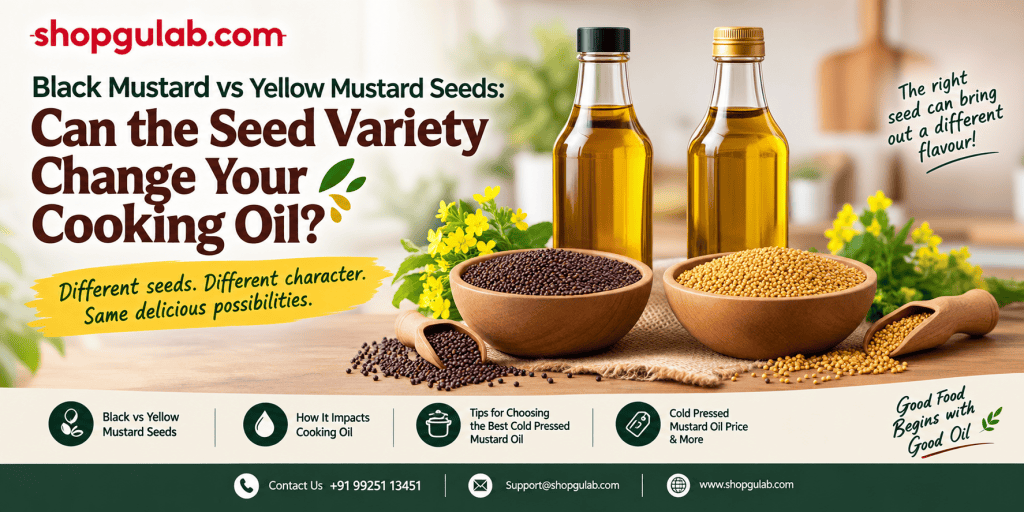
When people compare cold-pressed mustard oil, they often look at its colour, aroma, or pungency—but there is another factor worth understanding: the mustard seed itself. Black mustard seeds and yellow mustard seeds belong to different mustard groups, and their natural compounds can influence the aroma, pungency, and overall character of the oil produced from them.
That raises an interesting question: Can the mustard seed variety actually change your cooking oil?
The short answer is yes—but not in the simplistic way that “darker seed means better oil.” The variety, seed quality, extraction method, filtration, and subsequent handling all contribute to the final product.
Black Mustard vs Yellow Mustard: What Is the Actual Difference?
Black mustard is commonly associated with Brassica nigra, while yellow mustard is associated with Sinapis alba. Indian mustard varieties also include Brassica juncea, which is extremely important in traditional mustard-oil production.
These are not simply different-coloured versions of the same seed.
Their natural chemical profiles differ. For example, FSSAI’s mustard standards distinguish characteristic isothiocyanate compounds associated with different mustard species. The standard lists allyl isothiocyanate for B. nigra and B. juncea, while yellow mustard (S. alba) is associated with p-hydroxybenzyl isothiocyanate.
These compounds are part of what gives mustard its familiar sharp, pungent character.
So when two oils come from different mustard seeds, it is reasonable to expect some differences in sensory character.
Does Seed Variety Change the Taste of Mustard Oil?
Yes, it can.
Think about mustard seeds as you would think about different varieties of grapes used for wine. The raw material provides the starting point, but the final character is also shaped by processing.
With mustard oil, seed variety can influence:
- Aroma
- Pungency
- Sharpness of flavour
- Overall sensory intensity
- The character the oil contributes to cooked food
Black mustard is generally known for a stronger pungent profile, while yellow mustard has a somewhat different mustard character. However, the final oil cannot be judged simply by looking at the seed colour.
This distinction matters because consumers sometimes assume that a darker seed automatically produces a stronger or better oil. There is no sound basis for treating seed colour alone as a quality ranking.
What About Cold Pressed Mustard Oil?
This is where the extraction method becomes important.
Cold-pressed mustard oil is produced by mechanically pressing mustard seeds rather than relying on solvent extraction. FSSAI’s food standards define mustard oil as oil expressed from clean and sound mustard seeds, and the regulations also specify requirements for oils marketed as “Kachi Ghani” or “Cold Pressed.”
Because cold pressing is designed to retain the natural character of the raw material, differences between seed varieties may be more noticeable in the finished oil’s sensory profile.
But there is an important caveat: cold pressing does not make every oil identical to the seed from which it came.
Seed maturity, cleanliness, moisture, storage before pressing, pressing conditions, and filtration can all affect the result.
That is why two bottles of mustard cold-pressed oil can have noticeably different aromas even when both are described as traditionally extracted.
Can Yellow Mustard Produce Cooking Oil?
Yes, mustard oil can be produced from yellow mustard, but terminology needs some care.
The phrase cold-pressed yellow mustard oil can refer to oil obtained from yellow mustard seeds, while the mustard oil commonly sold in India may be produced from other mustard species or varieties, particularly Brassica juncea.
This is one reason consumers should read the product information instead of assuming that every mustard oil comes from the same botanical source.
If the seed variety is important to you, look for clear information from the manufacturer about the raw material and extraction process rather than relying on the colour of the oil alone.
Why Does One Mustard Oil Smell Stronger Than Another?
Pungency is not controlled by seed variety alone.
Mustard seeds contain compounds that can contribute to the characteristic mustard aroma and pungency. When seeds are processed, enzymatic reactions can contribute to the formation of volatile isothiocyanates responsible for the familiar sharp mustard sensation.
This helps explain why one bottle may have a powerful, nose-catching aroma while another feels comparatively mild.
The difference does not automatically mean that one is pure and the other is adulterated.
A better approach is to consider the complete picture:
Seed variety + seed quality + extraction + filtration + storage = final oil character
This is a much more realistic way to evaluate the best cold-pressed mustard oil than simply choosing the bottle with the strongest smell.
Does Darker Mustard Oil Mean Better Quality?
Not necessarily.
Oil colour can vary naturally depending on the mustard seed, extraction conditions, and filtration. A darker shade does not automatically prove that the oil is more authentic, just as a lighter shade does not automatically mean that it is inferior.
This is an important buying lesson because visual appearance is easy to judge but difficult to interpret correctly.
Instead of asking, “Which bottle looks darker?” ask:
- What mustard seeds were used?
- How was the oil extracted?
- Is the product properly labelled?
- Does the manufacturer provide clear product information?
- Is the oil fresh and properly packaged?
- Does the product meet applicable food-safety standards?
These questions give you much more useful information.
What Should You Check Before Buying Cold Pressed Mustard Oil?
The cold-pressed mustard oil price can vary considerably between products, but price alone should not determine your choice.
A practical buying checklist is more useful.
1. Read the ingredients and product information
Look for clear information about the oil and its source. Avoid making assumptions based only on the words “traditional” or “natural.”
2. Check the extraction claim
If the product is marketed as cold-pressed or Kachi Ghani, check whether the label clearly identifies it as such.
FSSAI’s standards provide specific requirements for the use of the “Kachi Ghani” or “Cold Pressed” description.
3. Don’t judge purity by colour
A naturally varying colour is not enough to establish quality.
4. Consider the aroma—but don’t use it as the only test
Mustard oil’s characteristic smell can tell you something about its sensory profile, but your nose cannot replace proper food-safety and quality testing.
5. Compare value, not just price
When comparing cold-pressed mustard oil prices, consider the pack size, extraction method, sourcing information, packaging, and overall product transparency.
A cheaper bottle is not necessarily better value, and a more expensive bottle is not automatically superior.
Black Mustard or Yellow Mustard: Which Is Better for Cooking?
There is no universal winner.
The better choice depends on the type of flavour you want and how the oil fits into your cooking.
If you enjoy a pronounced mustard character, an oil made from a naturally pungent mustard variety may suit you. If you prefer a different sensory profile, yellow mustard-derived oil may be worth exploring.
The important point is that seed variety changes the starting material; it does not by itself determine whether an oil is “good” or “bad.”
For everyday cooking, freshness, proper manufacturing, food-safety compliance, and suitability for the intended dish matter more than simply choosing the darkest or strongest-smelling oil.
A Note About Mustard Oil Standards
For readers who want to go beyond marketing claims, official standards are worth checking.
FSSAI’s food-product standards specify requirements for mustard oil and also distinguish characteristics associated with different mustard seeds. The standards address factors such as the source of the oil, quality characteristics, and requirements related to the use of terms such as “Kachi Ghani” or “Cold Pressed.”
You can refer to the official FSSAI food standards when you want to verify the regulatory details rather than relying on informal claims.
Final Takeaway
So, can black mustard and yellow mustard seeds produce different cooking oils?
Yes. Seed variety can influence the aroma, pungency, and sensory character of the resulting oil. But it is only one part of the story.
For cold-pressed mustard oil, the journey from seed to bottle matters. The mustard variety, seed condition, pressing process, filtration, packaging, and storage can all contribute to what eventually reaches your kitchen.
That is why choosing the best cold-pressed mustard oil should not come down to colour, smell, or cold-pressed mustard oil price alone. Look at the product information, understand what you are buying, and choose an oil that matches both your cooking preferences and your expectations for quality.
For product details or help choosing the right mustard oil for your kitchen, contact us at Shop Gulab, and our team will be happy to assist you.


Leave a Reply