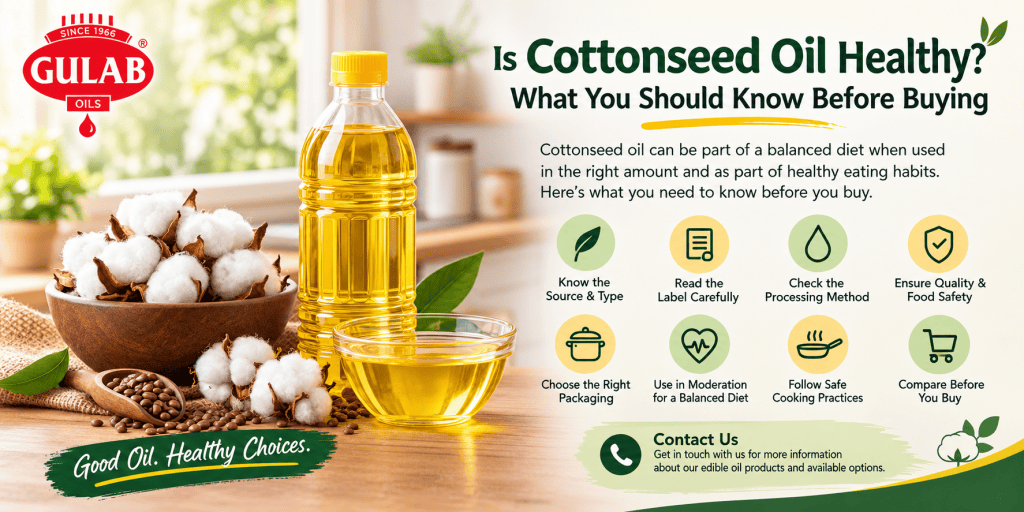
When people choose cooking oil, the decision often comes down to price, taste, or whatever their family has been using for years. But if you are considering Cottonseed Oil, it is worth looking beyond the front label. The type of processing, product quality, storage, and your overall diet all matter.
So, is Cottonseed Oil healthy? The most accurate answer is: it can be part of a balanced diet when used in appropriate amounts and as part of an overall healthy eating pattern. It should not, however, be treated as a miracle food or judged in isolation from the rest of your diet.
For shoppers looking at Cottonseed Oil India products, understanding what is actually inside the bottle can make the buying decision much easier.
What Is Cottonseed Oil?
Cottonseed oil is a vegetable oil obtained from cotton seeds. You may also encounter the term Kapasia Oil in Indian markets and product descriptions.
Like other edible vegetable oils, cottonseed oil is primarily a source of dietary fat. Fat itself is not something that needs to be eliminated from the diet. The World Health Organization notes that dietary fat is an essential nutrient, while emphasizing the importance of the type and amount of fat consumed.
That distinction is important because a cooking oil should be considered as part of the complete meal—not as a standalone health product.
Is Cottonseed Oil Healthy?
There is no simple “healthy” or “unhealthy” label that applies to every bottle or every person’s diet.
The better question is how the oil fits into your overall eating pattern.
Research and nutrition guidance generally place importance on replacing saturated and trans fats with unsaturated fats. WHO recommends shifting fat intake away from saturated and industrially produced trans fats toward unsaturated fats.
Cottonseed oil contains unsaturated fatty acids, including linoleic acid, an omega-6 polyunsaturated fatty acid. Harvard’s Nutrition Source identifies cottonseed oil among dietary sources of omega-6 fatty acids and notes that omega-6 fats are essential nutrients.
However, that does not mean you should consume unlimited amounts. All cooking oils are energy-dense, so quantity still matters.
What About the Fat in Cottonseed Oil?
This is one area where consumers should avoid oversimplified claims.
Vegetable oils contain combinations of saturated, monounsaturated, and polyunsaturated fats. The proportions vary from one oil to another. Historical USDA data, for example, show cottonseed oil containing substantial amounts of unsaturated fatty acids alongside saturated fat.
The practical takeaway is simple: don’t judge an oil only by its name. Look at the product information and consider how much oil you use overall.
Harvard Health similarly explains that seed oils are not inherently unhealthy and that their effects need to be considered in the context of the overall diet and how the oil is used.
Is Refined Cottonseed Oil Safe to Buy?
Refined Cottonseed Oil is processed to produce an oil suitable for cooking and with a relatively neutral sensory profile. Refining itself should not automatically be interpreted as meaning that an oil is unhealthy.
What matters more when shopping is whether the product complies with applicable food-safety requirements and whether the packaging provides clear information about the product.
FSSAI’s regulatory framework includes standards for edible vegetable oils and requirements concerning safety, quality, and labeling.
This gives consumers a useful starting point: buy a properly labeled product from a credible source rather than relying on marketing claims alone.
What Should You Check Before Buying Cottonseed Oil in India?
Before buying, it is also worth checking the applicable food-safety requirements rather than relying only on marketing claims. You can refer to the official FSSAI standards and regulations for information on edible oil requirements and food-safety standards.
1. Read the Product Label
Look for the product name, ingredient information, net quantity, manufacturer or marketer details, batch information, date information, and applicable regulatory declarations.
A transparent label makes it easier to understand what you’re purchasing.
2. Check the Packaging
The bottle should be properly sealed and free from leakage, damage, or signs of tampering.
For a family that cooks regularly, choose a pack size that you can reasonably use while maintaining proper storage after opening.
3. Understand the Processing
If the label says Refined Cottonseed Oil, understand what that means rather than assuming that “refined” automatically equals either good or bad.
Processing methods serve specific purposes, including removing unwanted components and creating a consistent cooking oil.
4. Don’t Make Health Decisions From Colour Alone
Colour is not a reliable standalone measure of nutritional quality.
A clear appearance may tell you something about processing and product condition, but it cannot tell you whether an oil is automatically healthier than another oil.
5. Consider Your Overall Diet
This is perhaps the most overlooked point.
If your meals already contain substantial amounts of fried foods, packaged snacks, sweets, and other energy-dense foods, simply switching between cooking oils will not transform the overall nutritional quality of your diet.
WHO recommends a varied diet built around foods such as vegetables, fruits, legumes, whole grains, nuts, and other nutritious foods, while keeping unhealthy fats and excessive energy intake under control.
Does Cooking Method Matter?
Absolutely.
The same oil can be used very differently depending on the cooking method. Regular home cooking, shallow frying, and repeated deep-frying are not the same thing.
One practical habit is to avoid repeatedly heating and reusing cooking oil. High-temperature and repeated heating can change the chemical characteristics of oils, which is one reason nutrition guidance encourages limiting fried foods and using sensible cooking practices.
For everyday meals, using a reasonable quantity of oil is generally more useful than obsessing over whether one particular vegetable oil is a “perfect” choice.
Cottonseed Oil vs. the “Healthy Oil” Debate
Social media often turns cooking oil into a simple good-versus-bad debate. One week, a particular oil is promoted as the healthiest; the next week, seed oils are criticized altogether.
Real nutrition is more nuanced.
Harvard Health notes that claims portraying seed oils as inherently harmful are not supported by the available evidence and emphasizes using oils wisely as part of an overall dietary pattern.
For consumers, this means there is no reason to choose an oil solely because of a viral health claim. Instead, consider fat quality, quantity, cooking habits, product quality, and the rest of your diet.
A Simple Cottonseed Oil Buying Checklist
Before putting a bottle in your shopping cart, ask:
- Is the product clearly labeled?
- Is the packaging sealed and undamaged?
- Is the processing method clearly mentioned?
- Is the manufacturer or marketer information available?
- Is the date information clearly visible?
- Does the product comply with applicable food-safety requirements?
- Does the pack size suit your household consumption?
- Are you using cooking oil in moderation as part of a balanced diet?
If the answer to these questions is satisfactory, you have a much more useful basis for choosing than simply looking at a promotional claim on the front of the bottle.
Final Thoughts
So, is Cottonseed Oil healthy? It can fit into a balanced diet when consumed in sensible amounts and used appropriately. Its nutritional value should be considered in the context of the type of fat it provides, your overall food choices, and your cooking habits.
For people shopping for Kapasia Oil, Refined Cottonseed Oil, or other Cottonseed Oil India products, the smartest approach is to read the label, check the packaging, understand the processing, and avoid exaggerated health promises.
A good cooking oil choice is ultimately about making a practical decision based on quality, quantity, and the overall diet—not a single health claim.
Gulab Oils focuses on edible oil products for everyday cooking and provides product information to help consumers make informed choices.
Contact Us: Get in touch with us for more information about our edible oil products and available options.


Leave a comment