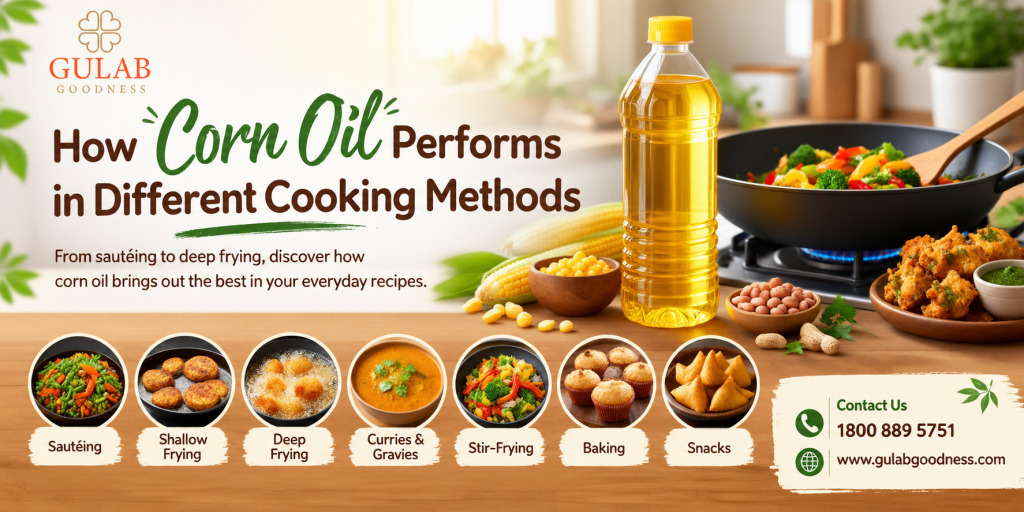
The same cooking oil can behave very differently depending on what you do with it. A light sauté, a hot frying pan, and deep frying all expose oil to different temperatures, cooking times, and amounts of food. That is why choosing an oil based only on its label or smoke point does not tell the whole story.
Corn Oil is commonly used because of its mild flavor, light texture, and versatility. Refined corn oil is particularly suited to everyday cooking because refining removes impurities and improves its performance when heated. Research reviews also show that the behavior of corn oil during cooking depends on temperature, heating time, food moisture, and the cooking method itself.
So, how does Corn Oil actually perform in different cooking situations? Let’s look at it from a practical kitchen perspective.
1. Sautéing Vegetables
Sautéing is one of the simplest ways to use Corn Oil. It works well when onions, garlic, vegetables, or spices need to be cooked in a small amount of oil over moderate heat.
Its relatively neutral flavor is useful here because it does not dominate ingredients such as cumin, ginger, garlic, green chillies, or fresh vegetables.
For an everyday sabzi, for example, you can heat the oil, add your tempering ingredients, and then add the vegetables. Keeping the heat controlled helps prevent unnecessary scorching while allowing the ingredients to develop flavor.
Kitchen tip: If the oil starts smoking before you’ve added your food, the pan is probably too hot. Lower the heat rather than allowing the oil to continue smoking.
2. Shallow Frying
Shallow frying requires more oil and generally higher heat than sautéing. This makes the oil’s heat-handling characteristics more important.
Corn Oil can be useful for shallow-frying foods such as cutlets, tikkis, stuffed parathas, or vegetable patties. Its mild taste allows the seasoning and outer crust to remain the focus of the dish.
The trick is not simply to turn the flame to maximum. A moderately hot pan usually gives you better control and reduces the chance of an outside layer browning before the inside is properly cooked.
3. Deep Frying
Deep frying places the greatest thermal demand on cooking oil. During frying, oil temperatures commonly reach roughly 150–190°C, and the oil can degrade through reactions such as oxidation and polymerization as heating becomes more severe or prolonged.
Corn oil is used for frying, and food-safety guidance from the USDA lists corn among oils suitable for deep frying. The USDA gives an approximate smoke point of about 410°F (210°C), while scientific literature notes that actual smoke points can vary according to refining, composition, and cooking conditions.
For Indian kitchens, this makes Corn Oil suitable for foods such as:
- Pakoras
- Pooris
- Bhajiyas
- French fries
- Fried snacks
- Breaded vegetables
However, one important distinction is often overlooked: an oil being suitable for frying does not mean it should be overheated repeatedly.
4. Cooking Curries and Gravies
Curries usually involve several stages: tempering spices, sautéing onions, browning ingredients, and simmering the final gravy.
Corn Oil can perform well throughout these stages because its mild flavor allows spices and other ingredients to remain prominent.
For dishes such as vegetable curry, paneer gravy, or tomato-based masala, start with a moderate amount of oil and allow the aromatics to cook gradually. Rushing the process with excessive heat can burn spices and onions before the gravy has developed its intended flavor.
5. Stir-Frying
Stir-frying needs relatively quick cooking at higher heat. Ingredients are generally cut into small pieces so they cook rapidly while retaining some texture.
Here, Corn Oil offers a useful combination of mild flavor and high-heat cooking capability. It can be used for vegetables, noodles, rice preparations, and Indo-Chinese dishes where you do not want the oil itself to dominate the finished recipe.
Practical tip: Prepare all ingredients before heating the pan. Once stir-frying begins, you have little time to stop and chop something without overcooking the ingredients already in the pan.
6. Baking
Oil behaves differently in baking because it is not being exposed directly to a hot frying surface.
Corn Oil can be used in recipes such as muffins, cakes, quick breads, and certain savory baked dishes where a liquid cooking fat is required.
Its relatively mild flavor can be helpful in recipes where you want the vanilla, cocoa, spices, fruits, or other ingredients to remain noticeable.
When substituting it into a recipe, however, remember that different fats can change texture. Butter, coconut oil, and liquid vegetable oils do not always behave identically, so following the recipe’s intended fat ratio is important.
7. Making Homemade Snacks
Indian kitchens frequently move from everyday meals to snacks without warning. One evening it might be pakoras; on another day, it could be homemade namkeen or fried potatoes.
This is another situation where Corn Oil can be practical. Its neutral taste works with strongly seasoned foods without adding another dominant flavor.
For better results, avoid overcrowding the frying pan. Adding too much food at once can cause the oil temperature to fall, resulting in uneven browning and greater oil absorption.
USDA guidance similarly warns that overcrowding a fryer can lead to uneven cooking and other frying problems.
8. What Happens When Corn Oil Is Heated for Too Long?
This is where responsible cooking matters more than simply knowing an oil’s smoke point.
As cooking temperature and heating duration increase, edible oils undergo chemical changes. Research has found that prolonged exposure to very high temperatures can accelerate oxidation and other degradation reactions.
That does not mean you should avoid Corn Oil for cooking. Instead, it means you should use sensible kitchen practices:
- Do not deliberately heat oil until it smokes.
- Keep frying temperatures under control.
- Avoid unnecessarily long heating periods.
- Remove burnt food particles from frying oil.
- Do not repeatedly reuse oil that has noticeably darkened, foamed, or developed an off smell.
These simple habits matter regardless of which edible oil you use.
9. Does Corn Oil Change the Taste of Food?
One of the practical advantages of Corn Oil is its relatively mild flavor. Corn oil is described in technical literature as having a mild characteristic taste and odor.
That makes it useful when the goal is to showcase the flavor of the food rather than the cooking fat.
For example, delicate vegetable dishes may taste different when prepared with a strongly flavored traditional oil. With a milder oil, the spices, vegetables, herbs, and sauces can remain more prominent.
10. Which Cooking Method Makes the Most Sense?
There isn’t one cooking method that automatically makes Corn Oil “better.” The right choice depends on the recipe and how the oil is handled.
| Cooking Method | How Corn Oil Performs | Practical Consideration |
| Sautéing | Very suitable | Use moderate heat |
| Shallow frying | Suitable | Maintain steady heat |
| Deep frying | Suitable when properly controlled | Avoid overheating and repeated use |
| Stir-frying | Suitable | Keep ingredients ready before cooking |
| Curries | Suitable | Works well with spice-based cooking |
| Baking | Suitable for recipes calling for liquid oil | Follow the recipe’s fat ratio |
| Homemade snacks | Suitable | Avoid overcrowding the pan |
A Practical Way to Use Corn Oil at Home
Instead of treating Corn Oil as an oil that should always be used at maximum heat, think about the cooking process.
For sautéing, start moderately.
For frying, bring the oil to the appropriate cooking temperature before adding food.
For deep frying, monitor the oil carefully and avoid repeated heating cycles.
For baking, measure it accurately because the oil becomes part of the recipe’s structure.
This approach gives you better control over flavor, texture, and cooking performance.
Final Thoughts
Corn Oil is a versatile cooking oil that can fit comfortably into many everyday cooking methods, from sautéing vegetables and preparing curries to shallow frying, deep frying, stir-frying, and baking. Its mild flavor makes it especially useful when you want the ingredients and spices to remain the stars of the dish.
The bigger lesson is that the performance of any cooking oil depends not only on the type of oil but also on temperature, cooking duration, food quantity, and how often the oil is reheated. Using sensible heat control and avoiding prolonged overheating can make a noticeable difference in the kitchen.
For quality edible oil options suitable for everyday cooking, Gulab Oils provides products designed for practical household use.
Have questions about choosing or using cooking oil? Feel free to contact us for more information.


Leave a Reply