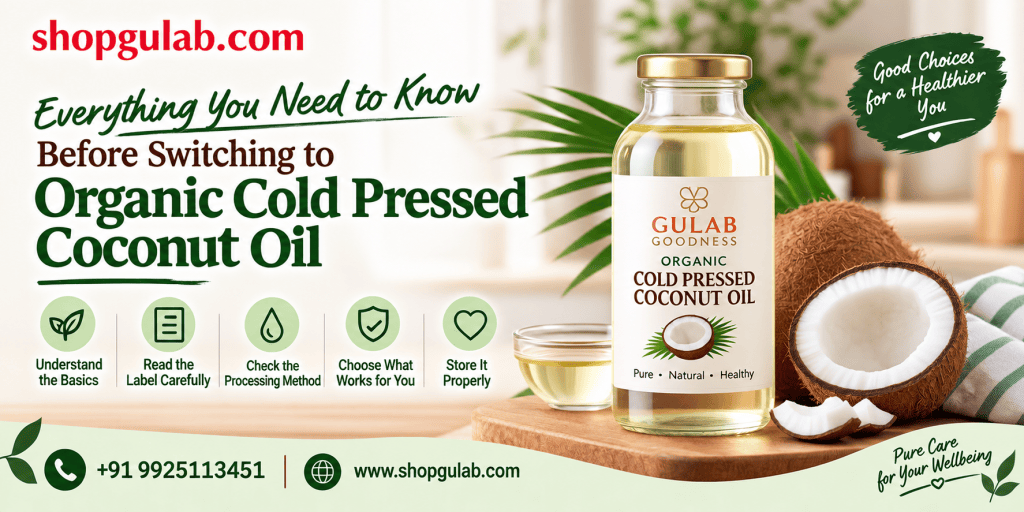
Switching cooking oils sounds simple until you stand in front of a shelf filled with bottles labelled virgin, organic, cold pressed, refined, and pure. The terms may look similar, but they describe different things.
If you are considering cold-pressed coconut oil for your kitchen, the smarter approach is not to follow a trend blindly. First, understand how the oil is made, what the label actually tells you, how it behaves during cooking, and whether it fits your overall eating pattern.
Here is what is worth knowing before making the switch.
What Exactly Is Cold Pressed Coconut Oil?
The phrase cold pressed coconut oil generally refers to oil obtained through a pressing or mechanical extraction process rather than conventional solvent extraction and subsequent refining.
However, don’t assume that the words “cold pressed” automatically mean “organic” or “virgin.” These are separate product characteristics.
FSSAI’s standards distinguish coconut oil from virgin coconut oil. Its current standards describe virgin coconut oil as oil obtained from coconut kernel by mechanical or natural means, with or without heat that does not alter the oil, and suitable for consumption without refining.
That distinction is useful when comparing products because a bottle can have several different claims on the front label, and each claim should be considered separately.
Organic and Cold Pressed Are Not the Same Thing
This is one of the biggest points to understand before switching.
Organic refers to the production and certification framework associated with the raw materials and product.
Cold pressed refers to the extraction method.
Virgin describes another category with its own product standards.
So, if you specifically want organic cold-pressed coconut oil, don’t assume that a bottle labelled “cold pressed” is automatically organic.
Instead, examine the certification and labelling information on the package.
FSSAI maintains separate regulations covering product standards as well as organic foods, packaging and labelling.
What Should You Look for on the Label?
A good label should answer basic questions without making you hunt for information.
Before buying, check:
- Ingredient declaration: What exactly is in the bottle?
- Processing description: Is the extraction method clearly stated?
- Certification information: If the product claims to be organic, is the claim supported by appropriate certification information?
- FSSAI details: Is the relevant licence information available?
- Batch or lot information: Can the product be traced?
- Dates: Check manufacturing/packing and best-before information.
- Storage instructions: Does the manufacturer explain how the product should be stored?
This is a much more reliable buying approach than choosing a bottle because its packaging looks premium.
Don’t Expect Every Bottle to Look Identical
One common mistake is assuming that genuine coconut oil must always have the same colour or texture.
Coconut oil can change from liquid to semi-solid or solid depending on temperature. Its appearance can also vary with processing and filtration.
Therefore, a change in texture caused by room temperature isn’t automatically a quality problem.
Likewise, a completely clear appearance isn’t by itself proof of superior quality.
Think of appearance as one observation, not an authenticity test.
How Does Cold Pressed Coconut Oil Fit Into Cooking?
This is where switching becomes a personal kitchen decision.
Coconut oil has a distinct flavour and aroma, which some people enjoy in traditional dishes, sautéing, baking, or recipes where coconut complements the other ingredients.
But you don’t have to replace every cooking oil in your kitchen on day one.
Try it first in dishes where its flavour makes sense. For example, it can work naturally with certain South Indian preparations, coconut-based curries, vegetable dishes, and some baking applications.
The practical question isn’t simply, “Can I cook with it?”
It’s:
Does its flavour, texture, cooking behaviour, and nutritional profile fit the foods I regularly prepare?
That is a much more useful way to decide.
Is Cold Pressed Coconut Oil Automatically Healthier?
This is where it is important to separate processing from nutrition.
Cold pressing describes how an oil is extracted. It does not automatically turn the oil into a universally healthier choice.
Coconut oil is a tropical oil and is relatively high in saturated fat. The American Heart Association recommends replacing sources of saturated fat, including coconut oil, with unsaturated plant oils as part of a heart-healthy dietary pattern.
So, switching to cold pressed coconut oil should not be presented as a guaranteed health upgrade.
If you’re choosing cooking oils for a specific medical or dietary reason, your overall diet and individual nutritional needs matter more than a single “natural” or “cold pressed” label.
That balanced perspective is important because better processing does not automatically mean unlimited consumption is appropriate.
Why Do People Choose It Anyway?
There are several practical reasons consumers are interested in cold-pressed coconut oil.
A More Traditional Processing Approach
People who prefer minimally processed foods may like oils produced through mechanical extraction rather than heavily refined processes.
Distinct Coconut Character
Cold-pressed coconut oil can have a noticeable coconut aroma and flavour, making it particularly appealing in recipes where that character is desirable.
Ingredient Simplicity
Consumers who prefer straightforward food products often look for oils with a simple ingredient declaration and clear processing information.
Versatility
A bottle can be used across different types of cooking, depending on the product specifications and the recipe.
The important point is to choose it because it suits your requirements—not because the phrase “cold pressed” appears in large letters on the label.
What About Refined Coconut Oil?
If you’re switching from refined coconut oil, you may notice differences in aroma, flavour, texture, and how the oil is presented.
Refining and mechanical extraction are different processing approaches, so the finished products need not have identical characteristics.
Rather than assuming one is automatically suitable for everyone, compare them based on:
| What to Compare | What to Look For |
| Processing | Understand how the oil was extracted and processed |
| Flavour | Consider whether you want a noticeable coconut character |
| Ingredients | Check what is actually listed |
| Certification | Verify organic claims where applicable |
| Cooking use | Match the oil to your recipes |
| Nutrition | Consider the complete dietary context |
| Storage | Follow the product’s instructions |
This gives you a more realistic comparison than simply asking which oil is “better.”
How to Make the Switch Without Wasting Oil
You don’t need to empty your existing bottle and immediately replace everything.
A gradual transition is often more practical.
Switching cooking oils sounds simple until you stand in front of a shelf filled with bottles labelled virgin, organic, cold-pressed, refined, and pure. The terms may look similar, but they describe different things.
If you are considering cold-pressed coconut oil for your kitchen, the smarter approach is not to follow a trend blindly. First, understand how the oil is made, what the label actually tells you, how it behaves during cooking, and whether it fits your overall eating pattern.
Here is what is worth knowing before making the switch.
What Exactly Is Cold Pressed Coconut Oil?
The phrase cold pressed coconut oil generally refers to oil obtained through a pressing or mechanical extraction process rather than conventional solvent extraction and subsequent refining.
However, don’t assume that the words “cold pressed” automatically mean “organic” or “virgin.” These are separate product characteristics.
FSSAI’s standards distinguish coconut oil from virgin coconut oil. Its current standards describe virgin coconut oil as oil obtained from coconut kernel by mechanical or natural means, with or without heat that does not alter the oil, and suitable for consumption without refining.
That distinction is useful when comparing products because a bottle can have several different claims on the front label, and each claim should be considered separately.
Organic and Cold Pressed Are Not the Same Thing
This is one of the biggest points to understand before switching.
Organic refers to the production and certification framework associated with the raw materials and product.
Cold pressed refers to the extraction method.
Virgin describes another category with its own product standards.
So, if you specifically want organic cold-pressed coconut oil, don’t assume that a bottle labelled “cold pressed” is automatically organic.
Instead, examine the certification and labelling information on the package.
FSSAI maintains separate regulations covering product standards as well as organic foods, packaging and labelling.
What Should You Look for on the Label?
A good label should answer basic questions without making you hunt for information.
Before buying, check:
- Ingredient declaration: What exactly is in the bottle?
- Processing description: Is the extraction method clearly stated?
- Certification information: If the product claims to be organic, is the claim supported by appropriate certification information?
- FSSAI details: Is the relevant licence information available?
- Batch or lot information: Can the product be traced?
- Dates: Check manufacturing/packing and best-before information.
- Storage instructions: Does the manufacturer explain how the product should be stored?
This is a much more reliable buying approach than choosing a bottle because its packaging looks premium.
Don’t Expect Every Bottle to Look Identical
One common mistake is assuming that genuine coconut oil must always have the same colour or texture.
Coconut oil can change from liquid to semi-solid or solid depending on temperature. Its appearance can also vary with processing and filtration.
Therefore, a change in texture caused by room temperature isn’t automatically a quality problem.
Likewise, a completely clear appearance isn’t by itself proof of superior quality.
Think of appearance as one observation, not an authenticity test.
How Does Cold Pressed Coconut Oil Fit Into Cooking?
This is where switching becomes a personal kitchen decision.
Coconut oil has a distinct flavour and aroma, which some people enjoy in traditional dishes, sautéing, baking, or recipes where coconut complements the other ingredients.
But you don’t have to replace every cooking oil in your kitchen on day one.
Try it first in dishes where its flavour makes sense. For example, it can work naturally with certain South Indian preparations, coconut-based curries, vegetable dishes, and some baking applications.
The practical question isn’t simply, “Can I cook with it?”
It’s:
Does its flavour, texture, cooking behaviour, and nutritional profile fit the foods I regularly prepare?
That is a much more useful way to decide.
Is Cold Pressed Coconut Oil Automatically Healthier?
This is where it is important to separate processing from nutrition.
Cold pressing describes how an oil is extracted. It does not automatically turn the oil into a universally healthier choice.
Coconut oil is a tropical oil and is relatively high in saturated fat. The American Heart Association recommends replacing sources of saturated fat, including coconut oil, with unsaturated plant oils as part of a heart-healthy dietary pattern.
So, switching to cold pressed coconut oil should not be presented as a guaranteed health upgrade.
If you’re choosing cooking oils for a specific medical or dietary reason, your overall diet and individual nutritional needs matter more than a single “natural” or “cold pressed” label.
That balanced perspective is important because better processing does not automatically mean unlimited consumption is appropriate.
Why Do People Choose It Anyway?
There are several practical reasons consumers are interested in cold-pressed coconut oil.
A More Traditional Processing Approach
People who prefer minimally processed foods may like oils produced through mechanical extraction rather than heavily refined processes.
Distinct Coconut Character
Cold-pressed coconut oil can have a noticeable coconut aroma and flavour, making it particularly appealing in recipes where that character is desirable.
Ingredient Simplicity
Consumers who prefer straightforward food products often look for oils with a simple ingredient declaration and clear processing information.
Versatility
A bottle can be used across different types of cooking, depending on the product specifications and the recipe.
The important point is to choose it because it suits your requirements—not because the phrase “cold pressed” appears in large letters on the label.
What About Refined Coconut Oil?
If you’re switching from refined coconut oil, you may notice differences in aroma, flavour, texture, and how the oil is presented.
Refining and mechanical extraction are different processing approaches, so the finished products need not have identical characteristics.
Rather than assuming one is automatically suitable for everyone, compare them based on:
| What to Compare | What to Look For |
| Processing | Understand how the oil was extracted and processed |
| Flavour | Consider whether you want a noticeable coconut character |
| Ingredients | Check what is actually listed |
| Certification | Verify organic claims where applicable |
| Cooking use | Match the oil to your recipes |
| Nutrition | Consider the complete dietary context |
| Storage | Follow the product’s instructions |
This gives you a more realistic comparison than simply asking which oil is “better.”
How to Make the Switch Without Wasting Oil
You don’t need to empty your existing bottle and immediately replace everything.
A gradual transition is often more practical.
Start by using cold pressed coconut oil for one or two suitable recipes. Pay attention to how your family responds to its aroma and flavour.
If you like the result, expand its use gradually.
This also prevents a common mistake: buying a large bottle because the product sounds appealing and then discovering that the flavour doesn’t suit your everyday cooking.
Storage Matters More Than Most Buyers Realize
Once you open the bottle, your handling habits become part of the quality equation.
Keep coconut oil in a cool, dry location away from unnecessary heat and direct sunlight. Close the bottle properly after use and use clean, dry utensils.
Don’t introduce water or food particles into the container.
And don’t panic if the oil becomes solid during cooler weather. Coconut oil naturally changes texture with temperature.
The best approach is simple: follow the manufacturer’s storage instructions and avoid unnecessary exposure to heat, moisture, and contamination.
How to Choose a Genuine Product
Before adding a bottle to your shopping cart, ask yourself a few questions:
1. Is the organic claim properly supported?
Don’t rely only on the word “organic” printed on the front.
2. Is the extraction method clearly explained?
Look beyond vague phrases such as “natural goodness.”
3. Is the ingredient list straightforward?
For a pure coconut oil product, the ingredient declaration should be easy to understand.
4. Are manufacturer and batch details available?
Traceability is an important part of responsible food labelling.
5. Does the packaging look properly sealed?
Avoid damaged or leaking containers.
6. Does the product match your intended use?
An oil chosen for everyday cooking should make sense for the recipes you actually prepare.
These checks take only a few minutes but can make the buying decision much more informed.
Don’t Let Marketing Decide Your Kitchen Routine
The biggest mistake when switching oils is treating the decision as an all-or-nothing lifestyle change.
You don’t need to believe that one oil is perfect and every other oil is bad.
Different oils have different flavour profiles, fatty-acid compositions, processing methods, and culinary uses. The American Heart Association specifically recommends emphasizing unsaturated plant oils over tropical oils such as coconut oil when choosing fats for a heart-healthy dietary pattern.
A sensible kitchen can therefore include different oils for different purposes.
The goal is to understand what you’re buying and use it appropriately.
A Smart Pre-Purchase Checklist
Before switching to cold pressed coconut oil, save this quick checklist:
- Read the complete label.
- Understand the difference between organic, virgin, and cold-pressed.
- Check the ingredient declaration.
- Verify relevant certification information for organic claims.
- Look for manufacturer and batch details.
- Consider the oil’s natural coconut flavour.
- Match it to your cooking habits.
- Don’t assume cold-pressed automatically means healthier.
- Consider saturated fat in the context of your overall diet.
- Follow the recommended storage instructions.
Final Thoughts
Switching to cold-pressed coconut oil can be a worthwhile change if its flavour, processing characteristics, and intended use fit your kitchen. But the decision should come from understanding the product rather than simply following a label trend.
Look at the processing method, certification information, ingredients, traceability, cooking application, and nutritional context. Most importantly, remember that organic, cold-pressed, and virgin are not interchangeable terms.
For consumers looking for clearly presented coconut-oil products and useful product information, Shop Gulab provides options designed to make the buying process easier and more transparent.
Contact us if you need product information or assistance before choosing your coconut oil, and our support team will be happy to help.
If you like the result, expand its use gradually.
This also prevents a common mistake: buying a large bottle because the product sounds appealing and then discovering that the flavour doesn’t suit your everyday cooking.
Storage Matters More Than Most Buyers Realize
Once you open the bottle, your handling habits become part of the quality equation.
Keep coconut oil in a cool, dry location away from unnecessary heat and direct sunlight. Close the bottle properly after use and use clean, dry utensils.
Don’t introduce water or food particles into the container.
And don’t panic if the oil becomes solid during cooler weather. Coconut oil naturally changes texture with temperature.
The best approach is simple: follow the manufacturer’s storage instructions and avoid unnecessary exposure to heat, moisture, and contamination.
How to Choose a Genuine Product
Before adding a bottle to your shopping cart, ask yourself a few questions:
1. Is the organic claim properly supported?
Don’t rely only on the word “organic” printed on the front.
2. Is the extraction method clearly explained?
Look beyond vague phrases such as “natural goodness.”
3. Is the ingredient list straightforward?
For a pure coconut oil product, the ingredient declaration should be easy to understand.
4. Are manufacturer and batch details available?
Traceability is an important part of responsible food labelling.
5. Does the packaging look properly sealed?
Avoid damaged or leaking containers.
6. Does the product match your intended use?
An oil chosen for everyday cooking should make sense for the recipes you actually prepare.
These checks take only a few minutes but can make the buying decision much more informed.
Don’t Let Marketing Decide Your Kitchen Routine
The biggest mistake when switching oils is treating the decision as an all-or-nothing lifestyle change.
You don’t need to believe that one oil is perfect and every other oil is bad.
Different oils have different flavour profiles, fatty-acid compositions, processing methods, and culinary uses. The American Heart Association specifically recommends emphasizing unsaturated plant oils over tropical oils such as coconut oil when choosing fats for a heart-healthy dietary pattern.
A sensible kitchen can therefore include different oils for different purposes.
The goal is to understand what you’re buying and use it appropriately.
A Smart Pre-Purchase Checklist
Before switching to cold pressed coconut oil, save this quick checklist:
- Read the complete label.
- Understand the difference between organic, virgin, and cold pressed.
- Check the ingredient declaration.
- Verify relevant certification information for organic claims.
- Look for manufacturer and batch details.
- Consider the oil’s natural coconut flavour.
- Match it to your cooking habits.
- Don’t assume cold-pressed automatically means healthier.
- Consider saturated fat in the context of your overall diet.
- Follow the recommended storage instructions.
Final Thoughts
Switching to cold-pressed coconut oil can be a worthwhile change if its flavour, processing characteristics, and intended use fit your kitchen. But the decision should come from understanding the product, not simply following a label trend.
Look at the processing method, certification information, ingredients, traceability, cooking application, and nutritional context. Most importantly, remember that organic, cold-pressed, and virgin are not interchangeable terms.
For consumers looking for clearly presented coconut oil products and useful product information, Shop Gulab offers options designed to make the buying process easier and more transparent.
Contact us if you need product information or assistance before choosing your coconut oil, and our support team will be happy to help.


Leave a Reply