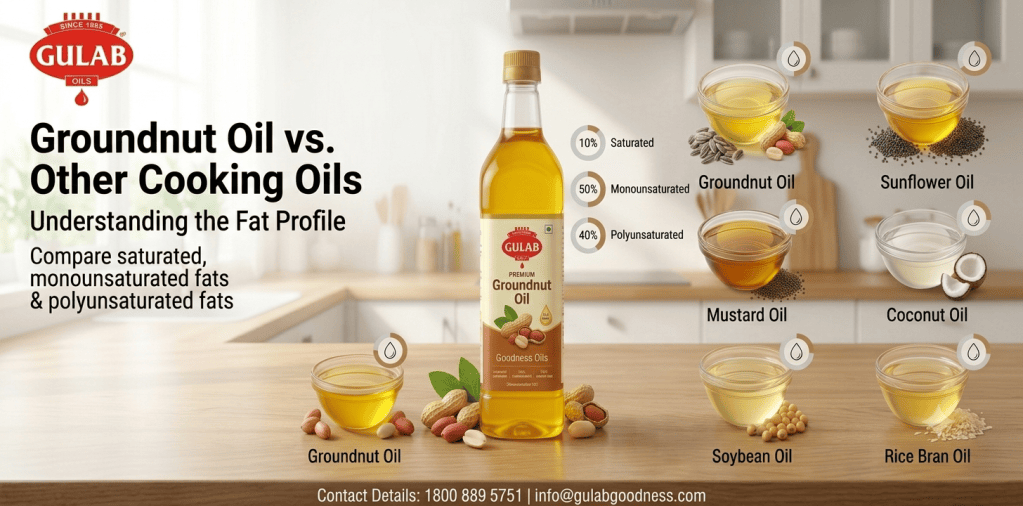
Walk into any Indian kitchen, and you will find more than one cooking oil competing for attention—groundnut, sunflower, mustard, soybean, rice bran, coconut, and others. The confusing part is that every bottle seems to have its own health story.
A more useful way to compare cooking oils is to look at their fat profile rather than relying on broad claims such as “light,” “traditional,” or “healthy.”
So, where does Groundnut Oil fit?
Groundnut Oil, also called peanut oil, contains a substantial proportion of unsaturated fatty acids, particularly oleic and linoleic acids. USDA research describes peanut oil as having a high proportion of unsaturated fatty acids, although the exact composition can vary with peanut variety and growing conditions.
Understanding that difference can make choosing an everyday cooking oil much easier.
What Does “Fat Profile” Actually Mean?
The phrase “fat profile” simply refers to the types and proportions of fats present in an oil.
The major categories are:
- Saturated fats
- Monounsaturated fats (MUFA)
- Polyunsaturated fats (PUFA)
- Trans fats
The body needs dietary fat, but different fats behave differently nutritionally. USDA FoodData Central classifies individual fatty acids according to their chemical structure, including saturated, monounsaturated, polyunsaturated, and trans fatty acids.
This is why comparing oils based only on total fat doesn’t tell the whole story. Nearly all cooking oils are predominantly fat; the more useful question is what kind of fat makes up that total?
Groundnut Oil: A Closer Look at Its Fat Profile
Groundnut Oil has a notable amount of monounsaturated fat, particularly oleic acid, along with polyunsaturated linoleic acid.
USDA research identifies oleic and linoleic acids as important components of peanut oil and notes that its fatty-acid composition can differ depending on the peanut variety and growing conditions.
This gives Groundnut Oil a different nutritional profile from oils dominated by other fatty-acid groups.
For someone choosing an oil for everyday Indian cooking, that distinction is more meaningful than simply asking which oil has the lowest calorie count. Cooking oils are calorie-dense foods, so the type of fat and the quantity used both deserve attention.
Groundnut Oil vs. Sunflower Oil
Sunflower oil is widely used for everyday cooking and generally contains a considerable amount of polyunsaturated fat, particularly linoleic acid. However, sunflower oils are not all identical; their fatty-acid composition can vary depending on the sunflower variety.
Groundnut Oil, on the other hand, generally has a stronger monounsaturated-fat component alongside polyunsaturated fat.
That difference matters because MUFA and PUFA are not interchangeable labels. They represent different types of unsaturated fatty acids with different chemical structures.
Rather than declaring one automatically “better,” compare the nutrition label and consider what other fat sources are already present in your diet.
Groundnut Oil vs. Mustard Oil
Mustard oil has a distinctive fatty-acid profile and is particularly familiar in many North and Eastern Indian cooking traditions.
Its strong aroma also makes it quite different from Groundnut Oil from a culinary perspective.
Groundnut Oil generally has a milder, nutty character, making it suitable for dishes where you don’t want the cooking oil to dominate the final flavour.
The choice between the two can therefore involve both fat composition and cooking preference. If you regularly prepare dishes where mustard’s characteristic flavour is part of the recipe, its culinary role is different from that of Groundnut Oil.
Groundnut Oil vs. Coconut Oil
This is one of the more noticeable comparisons because coconut oil has a substantially different fat profile.
USDA data on vegetable oils show that coconut oil contains a very high proportion of saturated fatty acids, while groundnut oil contains considerably more unsaturated fatty acids.
That doesn’t mean coconut oil has no place in cooking. It simply means the two oils should not be considered nutritionally identical.
If you’re trying to increase the proportion of unsaturated fats in your diet, understanding this difference becomes particularly relevant.
Groundnut Oil vs. Soybean Oil
Soybean oil generally contains a relatively high proportion of polyunsaturated fat, including linoleic acid, along with some monounsaturated fat.
Groundnut Oil has a different balance, with a substantial monounsaturated component.
USDA’s comparative data illustrate that vegetable oils can have noticeably different proportions of saturated, oleic, and linoleic fatty acids.
Again, this isn’t a simple competition. Your overall diet determines how useful a particular oil choice is.
For example, someone who already consumes substantial amounts of nuts, seeds, and other sources of PUFA may approach oil selection differently from someone whose dietary pattern contains relatively little unsaturated fat.
Groundnut Oil vs. Rice Bran Oil
Rice bran oil is another popular option in Indian kitchens. Like Groundnut Oil, it contains substantial unsaturated fat, but the exact fatty-acid distribution differs.
This is a good example of why comparing oils only by their names can be misleading.
Two oils can both be plant-based and suitable for cooking while still having different proportions of MUFA, PUFA, and saturated fat.
The label gives you more useful information than a generic claim that an oil is “light” or “premium.”
A Simple Comparison
| Cooking Oil | General Fat-Profile Characteristic | Typical Kitchen Consideration |
| Groundnut Oil | High in unsaturated fats, with a notable monounsaturated component | Versatile, mild nutty character |
| Sunflower Oil | Often relatively high in polyunsaturated fat | Common everyday cooking oil |
| Mustard Oil | Distinctive fatty-acid profile | Strong flavour, traditional Indian preparations |
| Coconut Oil | High in saturated fat | Distinct aroma and flavour |
| Soybean Oil | Relatively high in polyunsaturated fat | Neutral flavour, everyday cooking |
| Rice Bran Oil | Contains substantial unsaturated fats | Mild flavour and versatile use |
Exact values vary by variety, processing, formulation, and product. The table is intended as a general comparison rather than a substitute for the nutrition label of a specific product.
Does More Unsaturated Fat Automatically Make an Oil Better?
This is where online discussions often become too simplistic.
A food’s nutritional value cannot be judged from one number alone. An oil can have a favourable fat profile but still be consumed in excessive quantities.
The American Heart Association recommends replacing saturated fats with unsaturated fats rather than treating all dietary fats as equivalent. It also emphasizes the importance of the overall dietary pattern.
So, instead of asking:
“Which cooking oil is the healthiest?”
A more practical question is:
“Which oil fits my cooking style, dietary pattern, and nutritional needs—and how much am I actually using?”
That is a much more useful way to approach cooking oil.
How Much Groundnut Oil Should You Use?
Even a cooking oil with a predominantly unsaturated fat profile is still energy-dense.
One common kitchen habit is pouring oil directly from the bottle. Over time, this can make it surprisingly difficult to estimate how much is being used.
Try measuring the oil with a spoon when preparing everyday meals. You may discover that certain dishes need considerably less oil than you assumed.
Also remember that oil isn’t the only source of dietary fat. Nuts, seeds, dairy products, fried foods, sauces, and packaged foods can all contribute fat to your daily intake.
What About Cold-Pressed Groundnut Oil?
Cold-pressed and conventionally processed Groundnut Oil can differ in processing characteristics, flavour, aroma, and other properties. However, “cold-pressed” should not be treated as a nutritional shortcut.
The fat profile still matters, and the exact composition of an individual product can vary.
When buying cold-pressed Groundnut Oil, look beyond the front label. Check the ingredient information, packaging, storage instructions, and nutritional information.
A transparent label is much more useful than relying on marketing language alone.
What Should You Look for on a Cooking Oil Label?
Before buying Groundnut Oil or another cooking oil, check:
- Type of oil – Confirm which oil you’re actually purchasing.
- Nutrition information – Look at saturated and unsaturated fat values.
- Ingredients – Check whether the product contains only the expected oil or a blend.
- Packaging – Choose intact packaging and check the best-before information.
- Storage instructions – Follow the manufacturer’s guidance after opening.
- Suitability for your cooking – Consider whether you mainly sauté, temper, roast, or fry.
These simple checks are more useful than choosing a product solely because of a health-related claim on the front of the bottle.
The Bigger Picture: Your Overall Diet Matters
Choosing Groundnut Oil doesn’t compensate for an otherwise unbalanced diet.
Your overall eating pattern includes vegetables, fruits, pulses, whole grains, nuts, seeds, protein sources, dairy or alternatives, and the amount of processed and fried food you consume.
The oil is one component of that bigger picture.
For people with diagnosed cholesterol problems, cardiovascular disease, diabetes, or other conditions requiring dietary management, individual advice from a qualified healthcare professional should take priority over generic online guidance.
Final Thoughts
Groundnut Oil and other cooking oils have different fat profiles, and understanding those differences can help you make more informed kitchen choices. Groundnut Oil stands out for its substantial unsaturated-fat content, particularly its monounsaturated and polyunsaturated fatty acids. USDA sources also show that the precise composition of vegetable oils can vary, so product-specific information remains important.
The goal doesn’t have to be finding one “perfect” oil. Instead, consider the type of fat, how much oil you use, your cooking methods, and the rest of your diet.
For product information and cooking oil options, you can explore Gulab Oils.
For questions about products, availability, or usage, feel free to contact us through our customer support channels.


Leave a Reply